By Dr Anam Javed — Derma Care Specialist, JSK Specialist Clinic, Islamabad | Updated April 2026 Few medical treatments are as widely used — and as widely misunderstood — as Botox. Walk into any aesthetics clinic today and you will find patients asking for it by name, yet most cannot explain what it actually is, …

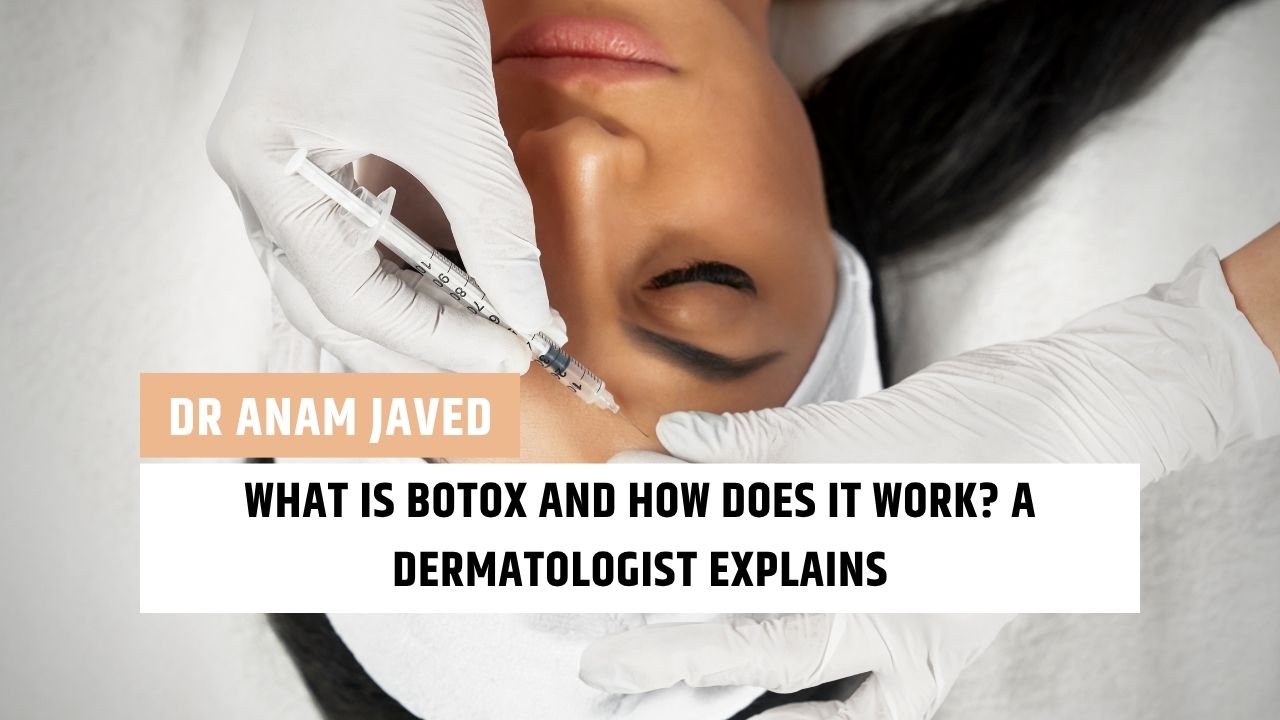
By Dr Anam Javed — Derma Care Specialist, JSK Specialist Clinic, Islamabad | Updated April 2026
Few medical treatments are as widely used — and as widely misunderstood — as Botox. Walk into any aesthetics clinic today and you will find patients asking for it by name, yet most cannot explain what it actually is, where it comes from, or what it does once it enters the body. As a dermatologist, I find that patients who understand their treatment make better decisions, have more realistic expectations, and feel more confident about the process. So let me walk you through everything you need to know.
What exactly is Botox?
Botox is the most widely recognised brand name for an injectable preparation of botulinum toxin type A — a purified protein derived from the bacterium Clostridium botulinum. In its natural, uncontrolled form, this toxin causes botulism, a serious paralytic illness. However, when it is purified, diluted to extraordinarily tiny concentrations, and injected with precision into a targeted site, that same substance becomes one of medicine’s most controlled and useful agents. The dose, as we say in pharmacology, makes the poison.
Other brand names you may encounter include Dysport, Xeomin, and Jeuveau — all botulinum toxin formulations, just manufactured by different companies with slightly different protein profiles. At JSK Clinic, we use clinically validated preparations and always discuss options with patients before treatment.
The science: how does Botox actually work?
To understand Botox, you first need to understand how a muscle contracts. Every time you squint, smile, or furrow your brow, your brain sends an electrical signal down a nerve fibre. At the very tip of that nerve, there is a tiny gap between the nerve ending and the muscle called the neuromuscular junction. To cross that gap, the nerve releases a chemical messenger called acetylcholine. When acetylcholine lands on the muscle, the muscle contracts.
The release of acetylcholine depends on a group of proteins called SNARE proteins, which act like docking clamps — they fuse tiny acetylcholine-filled sacs (vesicles) to the nerve cell’s membrane so the chemical can spill out. Without SNARE proteins, no acetylcholine is released, and the muscle simply cannot receive the signal to move.
“Botox does not freeze the face — it relaxes the precise muscle group being treated, leaving surrounding muscles completely unaffected.”— Dr Anam Javed, Derma Care Specialist
Here is where Botox enters the picture. The toxin molecule has two functional parts: a targeting unit that binds specifically to nerve endings at the neuromuscular junction, and an enzymatic unit that is smuggled inside the nerve cell. Once inside, this enzyme does one thing with remarkable precision — it cleaves and destroys SNARE proteins. The vesicles can no longer dock. Acetylcholine stays locked inside. The signal never crosses the junction, and the muscle relaxes not through any active process, but through the simple absence of a “go” command.
| Factor | Detail |
|---|---|
| Onset | Effects begin within 3–5 days; full result visible at 10–14 days |
| Duration | Typically 3–6 months, after which nerves regenerate new endings |
| Reversibility | Fully reversible — the nerve naturally regrows SNARE proteins over time |
| Amount used | Cosmetic doses are measured in units, far below any systemic threshold |
Why does the effect wear off?
This is one of the most common questions I hear in clinic. Botox does not permanently damage the nerve. Over roughly three to six months, the nerve terminal slowly sprouts new endings and rebuilds its SNARE protein machinery, restoring the neuromuscular junction to normal function. This biological regeneration is precisely why the effect fades — and why periodic top-up treatments are needed to maintain results. With consistent treatments over time, many patients find that their muscles gradually become less active, meaning results last longer between sessions.
What can Botox treat?
The cosmetic applications are the most familiar, but Botox’s medical uses are arguably more impressive. In both cases, the underlying principle is identical: quieting something in the body that is firing too strongly.
- Forehead lines — Relaxes the frontalis muscle to smooth horizontal creases
- Frown lines (11s) — Targets corrugator muscles between the brows
- Crow’s feet — Softens lines around the outer corners of the eyes
- Jaw slimming — Reduces masseter muscle bulk for a softer jawline
- Excessive sweating (hyperhidrosis) — Blocks sweat gland activation; highly effective for underarms
- Chronic migraines — Calms overactive pain signalling pathways in the head and neck
- Neck spasms (cervical dystonia) — Treats involuntary muscle contractions
- Gummy smile — Gently limits upper lip elevation to reduce gum visibility
Is Botox safe?
When administered by a qualified medical professional using approved preparations and correct dosages, Botox has an excellent safety record spanning over three decades of clinical use. It was first approved by the US FDA in 1989 for a medical eye condition, and its cosmetic approval followed in 2002. Serious side effects are rare and almost always linked to incorrect technique or unregulated products.
Common mild effects include temporary redness or bruising at the injection site, a mild headache on the day of treatment, or, rarely, a temporary drooping of the eyelid if the product migrates slightly — which is why precision technique and practitioner expertise matter enormously. I always conduct a thorough consultation before any treatment to assess facial anatomy and discuss realistic outcomes.
What to expect at your appointment
- Consultation: We discuss your goals, assess your facial anatomy, review your medical history, and agree on the treatment plan. There is no obligation to proceed on the same day.
- Preparation: The treatment area is cleansed. A topical numbing cream can be applied if preferred, though most patients find the injections very comfortable without it.
- Injection: Using a very fine needle, small doses are placed into precise muscle points. A typical cosmetic session takes 10–15 minutes.
- Aftercare: Avoid rubbing the area, strenuous exercise, and lying flat for 4 hours post-treatment. Results begin appearing within 3–5 days.
- Review: A follow-up at two weeks allows us to assess your results and make any minor adjustments if needed.
Frequently asked questions
Will I look frozen or unnatural?
Not with proper technique. The goal is always a natural, refreshed result. Botox should relax a specific muscle group — not eliminate all expression. This is why the skill and experience of your practitioner is the single most important factor in your outcome.
Can I get Botox for the first time in my 20s?
Yes — preventive Botox in the mid-to-late 20s is increasingly popular. By relaxing muscles before deep static lines form, you can delay the development of permanent creasing. I assess each patient individually to determine whether treatment is appropriate and beneficial at their age.
Does Botox hurt?
Most patients describe the sensation as a brief, mild pinch. The needles used are extremely fine, and the procedure is over within minutes. Topical anaesthetic cream is available for more sensitive patients.
How soon can I return to work or daily activities?
Immediately in most cases. There is no downtime. Some patients experience minor redness or pinpoint marks at injection sites that resolve within an hour or two.
What happens if I stop getting Botox?
Your muscles simply return to their pre-treatment activity level over time. Your face will not look worse than before — it will gradually return to its natural baseline as the treatment wears off.
Book a consultation with Dr Anam Javed
Dr Anam Javed — Derma Care Specialist
Clinic: JSK Specialist Clinic, Executive Complex, Markaz, near Excel Labs, G-8 Markaz, Islamabad 44000
Phone: +92 339 2050 505
Hours: Monday – Saturday | 5:00 pm – 7:00 pm | By appointment only
Book an Appointment
It’s easy and free!